 Page 1 of The Brave and the Bold #197 © 1983 and characters TM/® DC
Comics. Script: Alan Brennert. Pencils: Joe Staton. Inks: George
Freeman. Letters: John Costanza. Colors: Adrienne Roy.
This post is currently down for maintenance.
Tony Isabella noted on his blog earlier tonight that DC is finally soliciting a trade paperback collecting the original ’70s run of Black Lightning in the current Diamond Previews catalog for April release.
 I’m thrilled to hear this. Like so many who’ve met him and so many others who only know him through his writing or interactions online, I adore Tony — in part because of how he wears his considerably sized heart on his sleeve, yeah, but also because he’s made some excellent comics.
Tony was the first comics pro I ever interviewed, nearly 25 years ago now, followed
in very short order (at the same Mid-Ohio convention) by his good friend Bob Ingersoll and his new collaborator Eddy Newell. Eddy was the artist on a fresh, long-awaited Black Lightning series written by Tony, his creator, that wouldn’t debut for more than
a year. It proved to be a powerful take on humanity within the superhero genre that ended unhappily (to way understate the case) both for readers and for Jefferson Pierce’s real-world dad.
When plans for this collection were first uncovered via advance solicitation online last July, Tony shared details about his recent rapprochement with the DC PTB. Nothing is guaranteed in this world but gears seem to be moving in the right direction. I’m unsurprised to hear that, despite his paternal and proprietary feelings, Tony lobbied for the next volume to collect solo and team-up adventures written by other hands after his ’70s run ended, before we get to a Vol. 3 collecting those ’90s tales crafted by Tony and Eddy.
However, Vol. 1 has to sell well enough first. I’ll definitely be voting with my wallet and hope you do the same.
Panel from Black Lightning #5 © 1977 DC Comics. Script: Tony Isabella. Pencils:
Trevor Von Eeden. Inks: Vince Colletta. Letters: Ben Oda. Colors: Liz Berube.
Related: K-a Blam • Finding It • Uh-Oh
As I think I’ve said here before, I prefer to have a nice buffer between reading books
and watching the movies on which they’re based — with the book, ideally, coming first.
The film adaptation of Gillian Flynn’s Gone Girl is scheduled to open in early October, so I’m glad to have finished the novel last week. I don’t want to spoil even a bit of it for those who haven’t, but I will say that it’s both a page-turner of a mystery and a surprisingly dark, incisive look at domestic partnership.
While I’m not sure whether the film attempts to evoke the book’s structure, I suspect
by dint of that alone they’ll be different enough works that you could pick up the book in the next few weeks and have the movie feel like its own thing when it rolls out. I’m still chewing on the controversial ending; I recommend the book, though, and hope to read Flynn’s previous novels sometime.
Related: A Great Escape • Grit Expectations • Forest Gumption
I was finally successful this year in not writing about the Oscars before or after the event. The bad news is that this wasn’t due purely to willpower; I’ve been sitting on this post for a while with the aim of running it on, as they say, Movies’ Biggest Night, but I couldn’t.
Sometime last year I came up with a couple of the following lines and realized that the concept would make a fun hashtag game. What you do is take a reasonably well-known quote from books or films and substitute one or two words with food. I’m very rarely on Twitter anymore, though, so I ended up just brainstorming a bit and setting the list aside to run on the blog as my...
Top Twenty Supermarket Lines of Dialogue
20. “All right, Mr. DeMille, I’m ready for my cold cuts.”
19. “Nobody puts baked beans in a corner.”
18. “Take your stinking pasta off me, you damn dirty apes!”
17. “It was the best of thymes, it was the worst of thymes.”
16. “Open the pad thai doors, HAL.”
15. “There’s no cayenne in baseball!”
14. “Oh, Stewardess… I speak chives.”
13. “You’ve got meat? Who’s got juice?!?”
12. “Here’s looking at prunes, kid.”
11. “It’s the ship that made the Kessel Run in less than 12 parsnips!”
Of all the striking details in March Book One — and there are more than a few —
what I keep coming back to is this: At the age of five, John Lewis began preaching to
his family’s chickens.

Lewis, an organizer of the March on Washington in 1963 and since 1987 the U.S. Representative for Georgia’s Fifth District, is a great storyteller. March is a great story. I’ve just left those sentences alone after too much time spent considering adjectives other than “great” due to how easy and vague the word is, but it’s apt.
I was thinking recently about my school library in 3rd grade.
Not sure why. It could’ve been the recent news reports on libraries without books — without physical books, anyway; rather, they’re community spaces with computers where users can surf the Internet and check out E-books — that got me remembering how I’d settle down in the stacks in front of the encyclopedias and basically use the references in the article at hand like we use hyperlinks online today.
I have several fond memories, general and specific, of libraries. One suspects many readers do. Those I’ve shared on the blog before include — nestled in a post on TV’s Supernatural — memories of my favorite aisle in this particular library. What brought me to that aisle was books on Greek and Roman mythology, a subject I read about voraciously and to an almost literally exhausting degree. Based on periodic scans of various library and bookstore shelves, I may well have gone through every relevant volume in print. Some books were, from my youthful perspective at least, stuffier than others, a category in which I preferred Edith Hamilton’s Mythology to Bulfinch’s. There were plenty of slim paperbacks and large, illustrated tomes aimed more directly at my age, too, with D’Aulaires’ Book of Greek Myths atop the heap of the latter.
 This post is currently down for maintenance.
This post is currently down for maintenance.
42 Favorites: #1-3 ... #11 | #12 | #13 ... All
 As I mentioned in my last post, The Iron Giant is one of my favorite things.
 When the dad of a dear friend gave me a copy of Douglas Adams’ The Hitchhiker’s Guide to the Galaxy in 5th grade — for me, obviously, not for him — I’m sure I didn’t think of the cosmically resonant number of 42 in terms of the age I’d be over three decades hence.
And yet here we are. I don’t know if reaching, in human years, the Answer to the Ultimate Question of Life, the Universe, and Everything will impact my existence in any positive way but it’d sure be nice.
 This post is currently down for maintenance.
The downside to not sharing my entries in hashtag games here within a day or so of them being a thing on Twitter is that anyone interested in heading over there to see the full range of contributions will turn up zilch.
Maybe a hashtag comes back into fashion or someone joins in late or a totally different group of people hit on the same idea, maybe, but those earlier entries are gone. Twits seem to leave Twitter’s institutional memory pretty quickly, unless there are tricks to its search function I don’t know about (which is very, very possible). You can at least head to my own Favorites on Twitter, scroll down a bit, and see a heaping handful of others’ offerings that I found amusing enough to save. It’s not at all the same, though, as being in the thick of it — and this one, #unpromisingsequels, was a good one.
And so, in roughly the order they were posted, it’s time for my...
Top Twenty-Five Unpromising Sequels
25. The Day After the Day After
24. Hastily-Dressed Lunch
23. Monday in the Park without George
22. Acquaintances on a Train
21. Love in the Time of Cholera Vaccines
20. The Executive Producers
19. Fiddler at the Window
18. Evaporation Man
17. The Well-Scrubbed Dozen
In early August, Miss Violet DeVille asked for suggestions on Twitter for the title of a burlesque show based on the work of Neil Gaiman.
Naturally, I threw out a few ideas. They all riffed on Gaiman book titles; at least one of them was redundant to someone quicker on the draw.
While I’ve been thinking about running them on the blog as a Top X list, there are just five — and that’s counting the one that I came up with belatedly for the title of this post. So I decided to monkey with the covers to the books in question to spice things up visually. Comme ça:

You’re not gonna get these if you aren’t familiar with the original books, of course.
I didn’t read any reviews of Rachel Hartman’s delightful fantasy novel, Seraphina, before settling in to enjoy. The little I knew already felt like more than I should. A secret carried by the title character is revealed to the reader fairly early on and, I think, to be suspected well before that; still, even if a good story is often less about the What than about the How and the Why and the consequences of the What, it’s best to let the story unfold on its own terms.
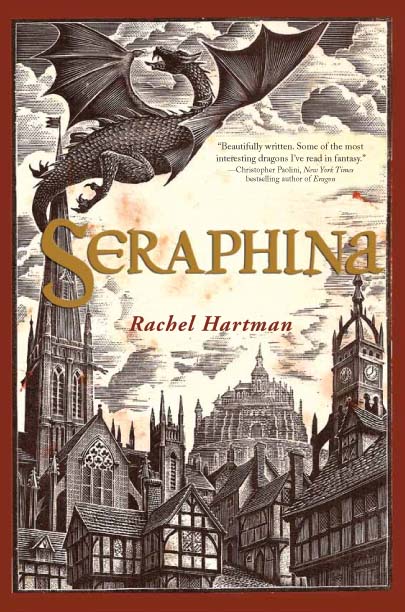
Avoiding chatter about Seraphina was hard because Hartman’s novel is clearly what they call in the book trade a triumphant debut.
Even with far more time and attention than I have right now it wouldn’t be possible
to do justice to Maurice Sendak with this post.

Sendak passed yesterday, at the age of 83, following a stroke. His career spanned
65 years and nearly 100 books as well as notable work in other media. You can find a timeline of his life and creations at the website of The Rosenbach Museum & Library, whose director also offers a nice remembrance of that Philadelphia institution’s relationship with the Brooklyn-born Sendak. (I recommend a visit to the place if you’re ever in town — its holdings include a large repository of Lewis Carroll memorabilia, James Joyce’s handwritten manuscript to Ulysses, and “over 10,000 Sendak objects, including original drawings, preliminary sketches, manuscripts, photographs, proofs, and rare prints of Sendak books.”) [Note: The specific links no longer lead to where they once did, unfortunately, nor does the Rosenbach still house Sendak’s papers, although it maintains his rare-book collection.]
 This post is currently down for maintenance.
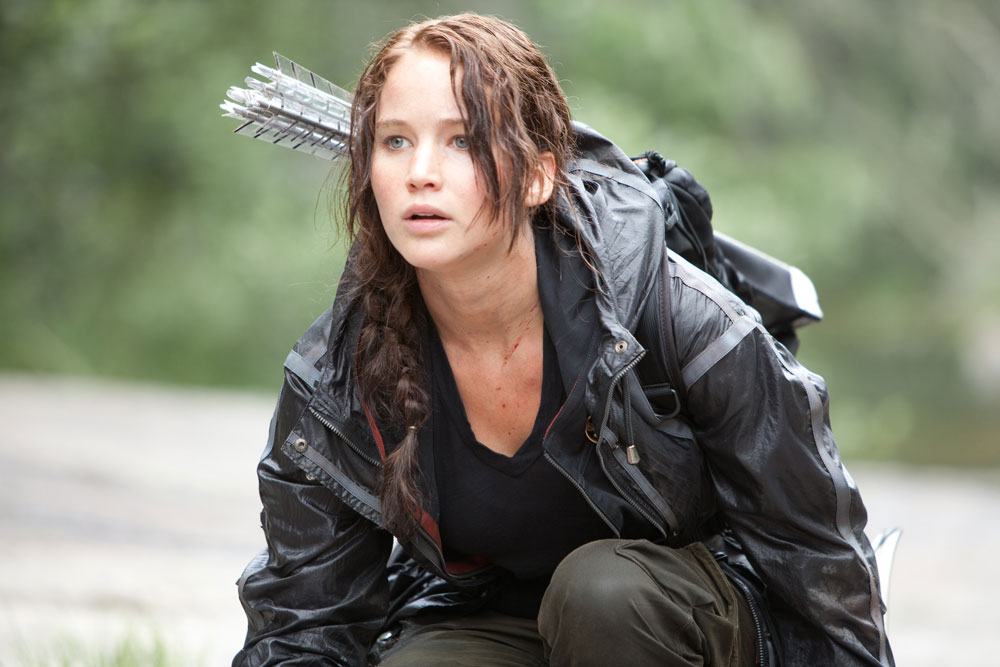 I saw The Hunger Games opening day. Based on the strength of Suzanne Collins' novel, on how good I expected Jennifer Lawrence to be in the lead role, and on advance word that the movie was not a complete travesty, I wanted to show my support for the film. So I was a small part of the $152.5 million it racked up that weekend in the US — making it third on the list of domestic opening weekends to date, behind 2008's The Dark Knight and 2011's final Harry Potter flick.
A few spoiler-free remarks follow.
 Photo © 2011 and characters TM/® The Muppets Studio LLC.
Above is a neat homage to the iconic, oft-mimicked Robert Freeman photograph
Photo © 2011 and characters TM/® The Muppets Studio LLC.
Above is a neat homage to the iconic, oft-mimicked Robert Freeman photograph
used on the cover to 1963’s With The Beatles and early the next year for the US release Meet The Beatles! It’s from a recent Parade article titled “Meet the Muppets (Again!)” — which is also the general theme of this post.


