 Page 1 of The Brave and the Bold #197 © 1983 and characters TM/® DC
Comics. Script: Alan Brennert. Pencils: Joe Staton. Inks: George
Freeman. Letters: John Costanza. Colors: Adrienne Roy.
This post is currently down for maintenance.
 Teddy Sears as Jay Garrick in The Flash Ep. 2.01 “Flash of Two Worlds” © 2015
CW Network. Photo: Cate Cameron. Character TM/® DC Comics.
I didn’t see Tuesday’s Flash episode until after midnight — so it ended up a birthday present. And it was a gift to all the fans who’ve loved DC’s multiverse for decades. I’m honestly not able to put my reaction into words, because it basically involved giving
the astral projection of my 6-year-old self a high-five.
The CW’s Flash/Arrow crossover last week was loads of fun.
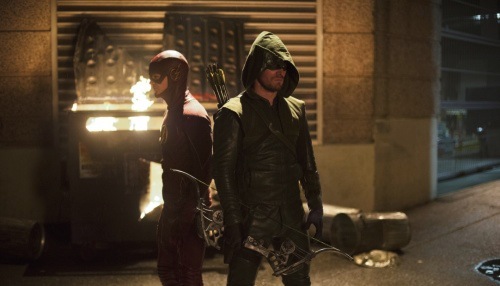 Still from The Flash 1.08 “Flash vs. Arrow” © 2014 CW. Photo: Diyah Perra.
I’d like to get to full-on reviews of both shows this season, but my inner 6-year-old demands that my adult self acknowledge this super-cool undertaking now. Just seeing
Still from The Flash 1.08 “Flash vs. Arrow” © 2014 CW. Photo: Diyah Perra.
I’d like to get to full-on reviews of both shows this season, but my inner 6-year-old demands that my adult self acknowledge this super-cool undertaking now. Just seeing
a green arrow slice through The Flash’s usual title sequence on Tuesday night and a lightning bolt flash through Arrow’s on Wednesday put a big, goofy grin on my face.
I was thinking recently about my school library in 3rd grade.
Not sure why. It could’ve been the recent news reports on libraries without books — without physical books, anyway; rather, they’re community spaces with computers where users can surf the Internet and check out E-books — that got me remembering how I’d settle down in the stacks in front of the encyclopedias and basically use the references in the article at hand like we use hyperlinks online today.
I have several fond memories, general and specific, of libraries. One suspects many readers do. Those I’ve shared on the blog before include — nestled in a post on TV’s Supernatural — memories of my favorite aisle in this particular library. What brought me to that aisle was books on Greek and Roman mythology, a subject I read about voraciously and to an almost literally exhausting degree. Based on periodic scans of various library and bookstore shelves, I may well have gone through every relevant volume in print. Some books were, from my youthful perspective at least, stuffier than others, a category in which I preferred Edith Hamilton’s Mythology to Bulfinch’s. There were plenty of slim paperbacks and large, illustrated tomes aimed more directly at my age, too, with D’Aulaires’ Book of Greek Myths atop the heap of the latter.
Man of Steel was released on home video a couple of weeks ago, which makes this
as good a time as any to finally post my full-on spoiler thoughts on the film.

This post is currently down for maintenance but I’ll point you to the roundtable discussion at Forces of Geek in which I participated and from which it draws.
How did I like Man of Steel?
That’s... a good question. I’ll be taking part in a roundtable discussion at Forces
of Geek soon, helping me further hone my thoughts for a proper review. What follows below is bereft of spoilers.
 Man of Steel image © 2013 Warner Bros. Entertainment. Superman ® DC Comics.
I went into the 12:01 a.m. screening last Thursday night with hope and tempered excitement.
Man of Steel image © 2013 Warner Bros. Entertainment. Superman ® DC Comics.
I went into the 12:01 a.m. screening last Thursday night with hope and tempered excitement.
“Okay. Here’s the situation.”
To a large swath of Generation X, at minimum, it’s danged near impossible to hear those words and not feel the urge to reply “My parents went away on a week’s vacation.”
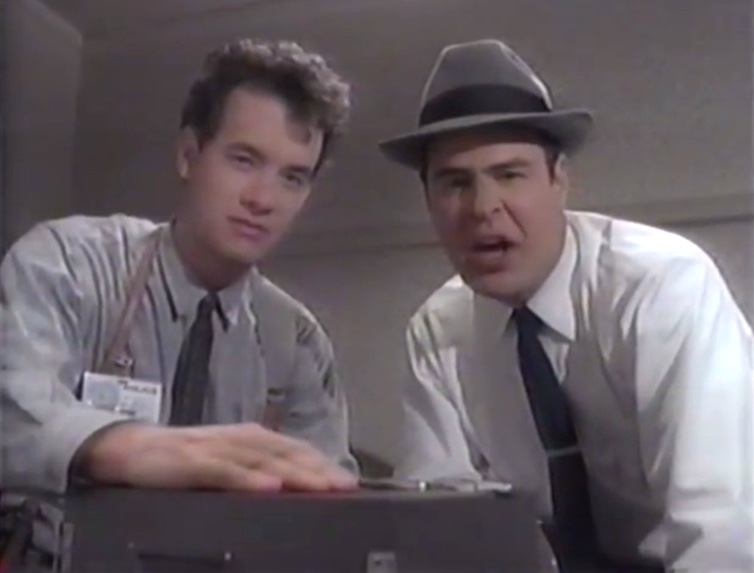
To a decidedly smaller segment of the population — we few who recall the music
video for “City of Crime”, a track played over the closing credits of the 1987 Dragnet movie — a similar trigger is provided by an even simpler and more mundane phrase: “Excuse me.”
 This post is currently down for maintenance.
 James Bond celebrated his 50th anniversary on the silver screen last year. Dr. No
hit theaters in 1962, based on the 1958 Ian Fleming novel of the same name (sixth in the Bond series). It made Sean Connery a star, launched a slate of films that would position Bond as a global icon for generations to come, and kicked off a spate of imitators capitalizing on the spy craze — some of which, like Mission: Impossible
and Get Smart, became icons of a certain size in their own right.
Was Skyfall, now out on home video, a worthy way to commemorate Bond’s golden jubilee?
 This post is currently down for maintenance.
We’re an hour away from Superman’s birthday, according to old comics lore.
Stories in various media conflict — even within their own continuity at times — over both when the Man of Steel was born on his homeworld of Krypton, relative to our Gregorian calendar, and when his rocket landed on Earth. As I wrote a few years back, though, DC Comics editor Julius Schwartz and writer/historian E. Nelson Bridwell noted in response to reader mail with a giant wink that Superman barely seemed to
age because his birthday only came around every four years.
 Panel from 1st story in Action Comics #1 © 1938 DC Comics.
Script: Jerry Siegel. Pencils, Inks, Letters: Joe Shuster. Colors: Unknown.
On the heels of the February 29th date seeing print in a 1976 DC calendar and those occasional lettercolumns, Alan Moore used it in the acclaimed tale “For the Man Who Has Everything”, drawn by his Watchmen co-creator Dave Gibbons for 1985’s Superman Annual. The same calendar gave alter ego Clark Kent’s birthday as June 18th, however, carried over from a 1973 story establishing the date as that of Kal-El’s arrival on his adoptive planet. Writer Cary Bates may have chosen that month based on the character’s 1938 introduction in the pages of Action Comics #1, bearing a cover date of June but on newsstands at least one month prior — despite which DC celebrated Superman’s 50th anniversary in 1988 with a party on the Friday before Leap Day, instead of in April, May, or June!
 Standard cover to Justice League #1 © 2011 and characters TM/® DC
Comics. Pencils: Jim Lee. Inks: Scott Williams. Colors: Alex Sinclair.
This post is currently down for maintenance.
Here’s a summary of the DC reboot I put together. For synopses of the 52 titles —
six posts on the 37 series in the main DC Universe line, plus one covering the 15 “Multiverse” projects — you can click through to each post. This was fun.
 DCU Part 1
Superman
— Writer: Peter J. Tomasi / Artist: Rags Morales
Batman
— Writer: Scott Snyder / Artist: Paul Azaceta
Wonder Woman
— Writer: Kathryn Immonen / Artist: Stuart Immonen
Aquaman
— Writer: Greg Rucka / Artist: Steve Epting
The Flash
— Writer: Paul Chadwick / Artist: Nicola Scott
Green Lantern
— Writer: Robert Kirkman / Artist: Ryan Ottley
Hawkman
— Writer: Kurt Busiek / Artist: Michael Gaydos
[continued from yesterday]
The Secret Six
Writer: Marc Andreyko / Artist: Stefano Gaudiano
Even among those beings of power and valor dedicated to patrolling the vast skies
and dank alleyways, few are aware of all that imperils humanity, peace, and the very existence of life as we know it. Yet through the ages demons and dark magic have ever lurked, and ever have six champions wielding sorcerous arts and artifacts been chosen by the mysterious Seventh to defend the world. The Secret Six follows the fractious endeavors of the latest such assembly, whose current membership consists of investigator Richard Occult; modern-day ronin Tatsu Yamashiro, alias Katana; the shaman known only as Doctor Mist; the enchantress named June Moon; the medicine woman called Manitou Dawn; and powerful but irreverent wizard John Constantine. Writer Marc Andreyko [DC’s Manhunter, Image’s Torso] and interior artist Stefano Gaudiano [DC’s Gotham Central, Marvel’s Daredevil], bring grim humor and grit to this crossroads of the literal and metaphorical underworld, with covers from The Unknown’s Erik Jones.
[continued from yesterday]
Action Comics
Writers: Bill Willingham, Jane Espenson, et al. /
Artists: Jesus Saiz, Amy Reeder, et al.
Metropolis has been ground zero for rapidly developing technology and metahuman activity since Superman’s arrival. Action Comics is an anthology set in America’s First City that explores the Man of Tomorrow’s friends and foes, from Lois Lane to Lex Luthor, in a variety of features — fronted by a look inside the Metropolis Special Crimes Unit written by Bill Willingham [Fables, Shadowpact] and drawn by Jésus Saiz [Manhunter, Checkmate]. Among the first round of rotating backups is a Daily Planet dramedy from Buffy the Vampire Slayer’s Jane Espenson and Madame Xanadu’s Amy Reeder; Kane creator Paul Grist waits on deck with a story about Mr. Action himself, Superman’s pal Jimmy Olsen, while Dan Panosian handles the covers.
[continued from yesterday]
Supergirl
Writer: Landry Q. Walker / Artist: Zander Cannon
While numerous extraterrestrials have appeared on Earth following Superman’s revelation to the world, none have concerned Kal-El more, in both senses of the word, than a girl named Kara. She claims to be the sole survivor of a Kryptonian lunar colony known as Argon, wiped out in the wake of Krypton’s destruction, but there’s no mention of Argon in what little information Superman has of his birthplace and the memory tapes in her spacecraft are Kara’s only evidence. Americans, Amazons, and even Atlanteans — most especially her occasional boyfriend — have embraced her, yet for all her charm questions about Supergirl remain. Landry Q. Walker provided a delightful spin on Kara Zor-El in Supergirl: Cosmic Adventures in the 8th Grade; now he transfers to the brand-new DC Universe proper to teach some revised history. The Replacement God creator and Top Ten artist Zander Cannon handles the interior art with covers illustrated by Age of Bronze’s Eric Shanower.
I’m finally picking up the geeking out that is my DC reboot again with mere days to
go until the real thing hits. As I wrote in a preface two months ago in greater detail, I’ve gone for broke on a friend’s challenge to come up with 52 titles and attendant creative teams relaunching DC’s main superhero line just as the company itself is doing; I couldn’t help devising springboard premises for many of them as well. My first and second capsule-bible posts covered 10 of the 37 series taking place in the new core DC Universe, while my third covered 15 mostly independent Multiverse projects. Another 12 of the DC Universe series appear today and tomorrow with the final 15, all anthologies or team titles, to be published as soon as possible.
Starman
Writer: Jeff Parker / Artist: Rafael Albuquerque
The Starman name first belonged to a second-string superhero and was then bequeathed upon a litany of lesser lights until a legacy was built around the label over
a dozen years ago. Now the newest DC Universe is seen through the eyes of its newest champion as another Starman is born at the hands of writer Jeff Parker [Marvel’s Hulk and X-Men: First Class], who reinvented characters from a bygone era for DC’s distinguished competition in Agents of Atlas. Rafael Albuquerque [Blue Beetle, American Vampire] applies his fluid yet crisp linework as interior and cover artist.
 Art © 2011 DC Comics. Pencils, Inks: Francis
Manapul. Colors: Brian Buccellato.
I guess the new “52” initiative from DC, which rewrites the continuity of its main superhero universe (again) together with setting up a comprehensive digital-release plan for its comics, gives another meaning to “downloading the latest version of
Flash”.
[continued from yesterday]
I’m taking a break from listing the 37 main DC Universe titles in my DC reboot,
due in part to issues recovering files after the latest round of computer woes, to share the 15 series of the overall 52 that are part of the non- or alternate-continuity DC Multiverse line-within-a-line. (As with the actual DC relaunch, my 52 titles only cover the core DC continuity dominated by superhero adventure, not the Vertigo imprint, licensed-property titles, titles aimed primarily at younger readers, and so forth.)
The first trio consists of series divorced from continuity with rotating features and creative hands. While everything after that — save for the last title — stands on its own, a couple of series are linked by virtue of being set in the same fictional reality. You can of course rest assured that all the old stories you love still “exist” somewhere out there as well...
My rationale for superhumans and even supertech in this new multiverse paradigm
is that when Kal-El’s rocket arrived from Krypton its wormhole brought with it massive energy that over time accounts for the development or at least the gone-into-overdrive mutation of a metagene whose effects vary from enhanced intelligence to hardiness and longevity to staggering powers in a small but significant minority of the population. That’s something I recall discussing with other fans way back when Crisis on Infinite Earths brought about the first intentional overhaul of DC cosmology 25 years ago; I don’t remember at this point whether we came up with it ourselves or it was suggested by a likely culprit such as John Byrne, Marv Wolfman, or Len Wein in the comics press. The parallel realities in my multiverse differ in when or if a Kryptonian craft landed on Earth, with the debut of Superman or his analogue occurring in ways both strange and familiar yet always marking a kind of singularity in each reality’s development of supernormal phenomena.
All-Star Comics
Batman Beyond
The Brave and the Bold
Writers / Artists: various
All-Star Comics is an anthology that allows contributors from within and without the comics industry to present their takes on characters and concepts spanning DC’s rich and varied history — from Superman to the Sea Devils to Space Cabbie. Of course, almost everyone gravitates towards a certain Dark Knight when invited to dabble in the DC realm, so there’s also Batman Beyond for that very purpose. The Brave and the Bold lives up to its title by inviting creators to conjure up sequels to and/or “remixed” versions of classic tales.
[continued from yesterday]
The Atom
Writer: Mark Waid / Artist: Chad Hardin
Ray Palmer has disappeared and Ryan Choi aims to find him, but if, as Ryan suspects, his former physics professor has shrunk to submolecular size, that’s like searching for a needle in a haystack among a nearly infinite succession of barns. Meanwhile, as The Atom, he’s put through his paces as a fledgling superhero by master craftsman Mark Waid [Kingdom Come], who expertly probes the perspectives of those with seemingly impossible abilities, here joined by his Traveler fellow Chad Hardin [Countdown to Mystery]. The stunningly detailed Geof Darrow is on cover duty.

