 I saw Dark Phoenix this summer and, not for the first time, was amazed at how my reaction to a $200 million effects-laden event film with bankable stars reprising popular roles could be “That was it? Eh.”
No spoilers ahead.
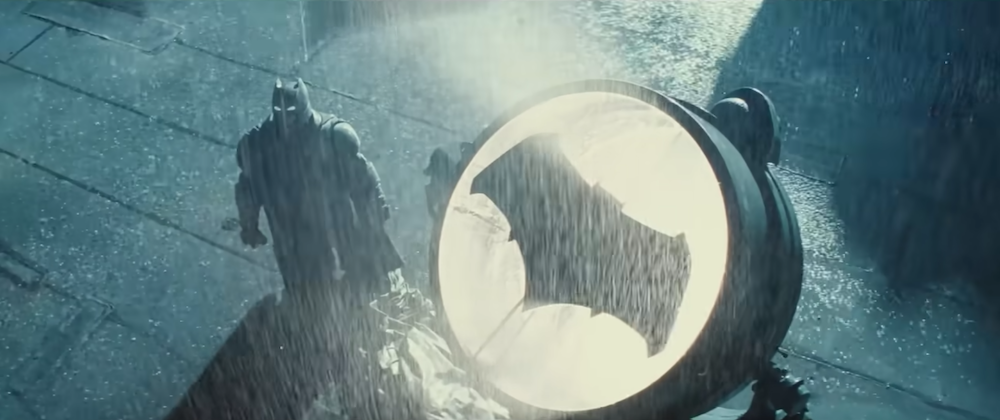 We got a new trailer for Batman v. Superman: Dawn of Justice last month to coincide with the sprawling media crush of San Diego’s Comic-Con International.
I’ll admit that the movie looks impressive on its own terms. While Man of Steel had potential as a riff on the superhero genre with a heavy sci-fi bent, however, it was a terribly misguided Superman film. Based on the footage and conversations regarding its sequel, Zack Snyder continues to be at least as far off target in translating DC’s oldest, greatest icons from page to screen as he was in adapting Watchmen a half-dozen years back. (Read my non-spoiler post or my longer review of Man of Steel, and my detailed review of Watchmen, for more.)
Snyder et al. have jumped right to Frank Miller’s Dark Knight — a possible future extrapolating from the comics of the time in which a weathered Batman comes out of retirement and tangles with a godlike Superman whom he views as too powerful and too simplistic in the embrace of justice and the American Way — by setting up that dichotomy in the characters’ first meeting absent the weight of their history together. Huh?
 Kate Willaert, creator of a bunch of cool stuff over at her Uncool Artblog no matter what the name says, has designed an infographic charting IMDB user ratings and domestic theatrical gross (adjusted for inflation) across movie quadrilogies — film series that have produced at least four installments. The diminishing returns come as no surprise, although there are exceptions to that general rule. Film series sampled aren’t nearly as numerous as those used in BoxOfficeQuant’s sequel map, which I shared a few years ago, but of course even in our current cinematic climate there are plenty more franchises with just one or two follow-ups than three or more.
Related: The A Team • Star Trek Too • After-Math
I found Iron Man 3 a fine kickoff to what Marvel Studios is calling Phase Two of the Marvel Cinematic Universe — Phase One having culminated in the assemblage of nearly every superhero thus far introduced to the MCU in 2012’s The Avengers.
 Given that it builds deliberately on what’s come before, Iron Man 3 isn’t an optimal entry to the series; a familiarity with the characters and their milieu is recommended.
If you’ve enjoyed the previous films, however, Robert Downey Jr.’s Tony Stark in particular, grab a ticket. For darn sure it’s better than 2010’s Iron Man 2, although certain flaws of that movie are revisited. The way in which 3 gets to jump straight into its world, history established, might even make it more fun than 2008’s original. In that regard (and in some aspects of the plot) it’s not unlike an installment of the Bond franchise, a parallel driven home at the very end and made explicit too in press interviews by co-writer/director Shane Black.
So there’s a quickie assessment. I’ll add spoiler commentary after the next graphic.
Join me below if/when you’ve seen Iron Man 3 or just don’t care...
The Bourne Identity, which introduced Matt Damon as human weapon Jason Bourne in 2002, was very good. Its 2004 sequel, The Bourne Supremacy, was great, as was 2007’s The Bourne Ultimatum. Last year’s The Bourne Legacy, a spinoff focused on another agent played by Jeremy Renner, was not as good as any of them but had its moments nonetheless. I’ll expound a bit, without spoilers, after the poster.

 This post is currently down for maintenance.
 James Bond celebrated his 50th anniversary on the silver screen last year. Dr. No
hit theaters in 1962, based on the 1958 Ian Fleming novel of the same name (sixth in the Bond series). It made Sean Connery a star, launched a slate of films that would position Bond as a global icon for generations to come, and kicked off a spate of imitators capitalizing on the spy craze — some of which, like Mission: Impossible
and Get Smart, became icons of a certain size in their own right.
Was Skyfall, now out on home video, a worthy way to commemorate Bond’s golden jubilee?
The downside to not sharing my entries in hashtag games here within a day or so of them being a thing on Twitter is that anyone interested in heading over there to see the full range of contributions will turn up zilch.
Maybe a hashtag comes back into fashion or someone joins in late or a totally different group of people hit on the same idea, maybe, but those earlier entries are gone. Twits seem to leave Twitter’s institutional memory pretty quickly, unless there are tricks to its search function I don’t know about (which is very, very possible). You can at least head to my own Favorites on Twitter, scroll down a bit, and see a heaping handful of others’ offerings that I found amusing enough to save. It’s not at all the same, though, as being in the thick of it — and this one, #unpromisingsequels, was a good one.
And so, in roughly the order they were posted, it’s time for my...
Top Twenty-Five Unpromising Sequels
25. The Day After the Day After
24. Hastily-Dressed Lunch
23. Monday in the Park without George
22. Acquaintances on a Train
21. Love in the Time of Cholera Vaccines
20. The Executive Producers
19. Fiddler at the Window
18. Evaporation Man
17. The Well-Scrubbed Dozen
 Last Friday the title of the 2013 sequel to J.J. Abrams’ 2009 Star Trek movie was announced. The site at the preceding link and other news outlets report it as Star Trek Into Darkness [sic].
Um... Okay.
I hope that, if the title sticks, someone at Bad Robot or Paramount realizes that it
either has to be Star Trek: Into Darkness or Star Trek into Darkness, with the preposition uncapitalized.
 Photo from The Muppets © 2011 Disney.
This post is currently down for maintenance.
 This post is currently down for maintenance.
A website called BoxOfficeQuant put together an intriguing graph last month. The Sequel Map charts Rotten Tomatoes’ average scores for various sequels against the films from whence they sprang. Forget Alien vs. Predator; this is Alien vs. Aliens.
 The Sequel Map © 2011 Edmund Helmer.
You’ll find a clickable version of the graph in BOQ’s post. Hit it and you’re taken to a larger image; hit that image and it zooms in wherever your cursor is to the extent that you can actually read the movie names amidst the circles. If, as happened with me, the graph doesn’t quite register with you at first, all you have to do is realize that it’s been shifted 45° to make the dotted line horizontal — just cock your head to the right.

