Big hype surrounded NBC’s The Event, promoted as what the name says — a cross between Lost and 24 in its mythology, conspiracy, government intrigue, large cast of characters, and fractured narrative. I was more than willing to give it a chance, despite having been burned plot-wise by Lost in its final season and to a lesser extent by fellow ABC shows The Nine and FlashForward not going beyond a first season.
One reason why: Event’s showrunners promised both that answers to smaller
mysteries would be rolled out gradually and that they had an early endgame in position if the series wasn’t renewed. Another: Really good television is never a waste of time even if it’s not allowed to reach a conclusion (which, just to spit in Lost’s general direction again, may be preferable to reaching to a poor conclusion or, more to the point, giving up on large parts of the story in creating one). Yet another: I figured I’d
be able to ditch The Event if it truly became unsatisfying and, until that point, have a potentially exciting show to dissect with friends.
 cover to Green Lantern: No Fear
I should have saved last week’s post on Fringe’s crimson revision of DC Comics’ emerald adventurers for today. Migraines and other obstacles have put the squeeze on this piece. But it’s only St. Patrick’s Day for 18 hours more at most anywhere on the planet, so in the spirit of my green-themed posts from 2009 and 2010, here’s another one.
 Glee last week was in many ways not at its best but at its most — at its most plot-oriented, at its most gimmicky, at its most disposable, at its most thematic, at its most randy, at its most heartfelt, and as the previous contradictions indicate at its most all-over-the-place. Case in point: John Stamos on drums while the unlikely members of McKinkley High’s celibacy club — Rachel, Quinn, Puck(!) — joined their literally virginal, newlywed guidance counselor Miss Pillsbury to perform one of my favorite tunes, Starland Vocal Band’s “Afternoon Delight” [3:02].
I really need to write about Fringe more often. A couple of friends have been urging me to do periodic if not weekly reviews, but that’s almost certainly not in the cards. While I’m hoping to publish at least some thoughts about what’s happened on the show since my first major post on it this time last year, soon, right now I just want to finally clear my metaphorical desk of several images that have been on the docket to share for nearly that long.
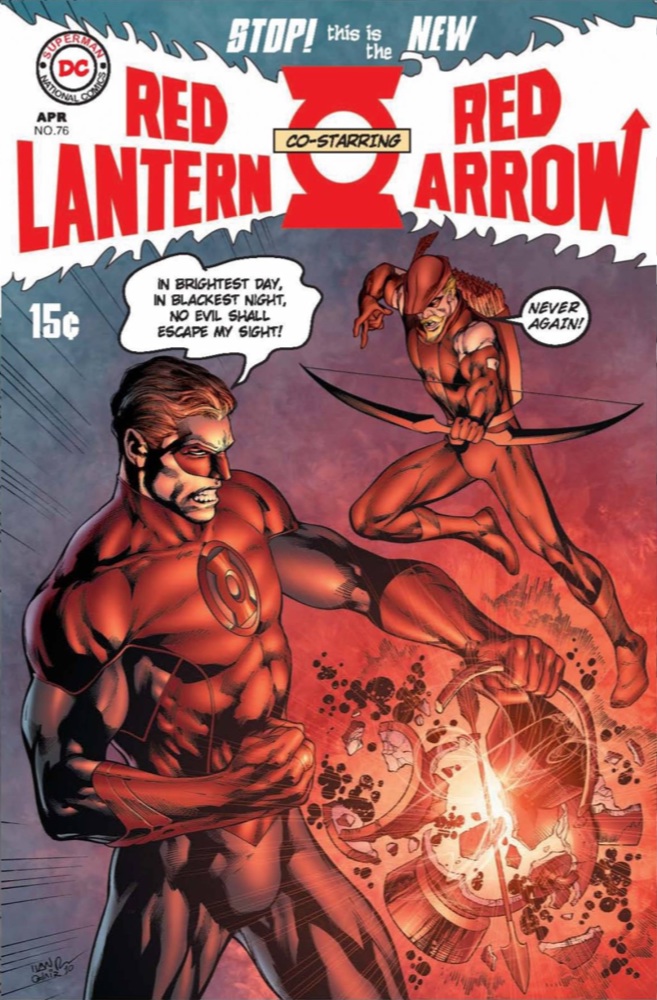

The week after I finally got that piece up, Fox aired one of Fringe’s best episodes — confirming Peter Bishop’s origins and blowing the show’s mythology wide open. “Peter” was a flashback to 1985, with awesomely retro opening credits; it showed the Walter Bishop of the standard Fringe universe spying upon the denizens of a parallel universe whose history and technology were slightly divergent from the familiar but which was inhabited largely by close counterparts of Fringe’s Earth. Later in the season Peter Bishop returned to the alternate universe in the present day, and in Part Two of May’s season finale “Over There” we saw some intriguing framed comic-book covers in his room.
I have more conversations about Spider-Man: Turn Off the Dark with folks who don’t read comics than with folks inside the hobby and business. Part of that, I suspect, is because I’m not very plugged into the comics world these days. But part of it is also because the show’s talent, spectacle, and travails are intriguing — yet “comics people” already know, in a way others might not stop to realize, that Dark has little to do with comics at all.
 Poster © 2011 Marvel Entertainment. Art/Design: Unknown.
Spider-Man comics, as well as the in-revival Spider-Man movie franchise and general merchandising, will be fine no matter what happens on stage. Neither Tim Burton’s 1989 Batman film nor the Christopher Nolan takes in 2005 and 2008, all of which were blockbusters, had any appreciable affect on comics readership except in ancillary fashion: The long-running Batman animated series that launched on Fox in 1992, now one of the most definitive and well-respected versions of the Dark Knight mythos, was influenced by — even more to the point, made attractive to Fox and Warner Bros. by — the 1989 film’s success and the 1992 release of Batman Returns. Many of the creative personnel of that series worked on comics set in the animated continuity (yes, it’s art imitating art imitating art) for DC, and Harley Quinn, created as The Joker’s gun moll especially for the show, was eventually introduced into the mainstream Batman comics. In terms of brand awareness through DVD sets and related items like toys, Halloween costumes, and not-quite-comics storybooks, more kids might have been introduced to Batman than would have had Bruce Timm and friends’ string of animated series from the Caped Crusader’s to the action-figure bonanza Justice League Unlimited not been such a success, but the films themselves didn’t drive adult moviegoers to comics shops; a Spider-Man musical is going to interest a larger number of comics readers in Broadway than it will Broadway regulars in comics, and that number will be small.
 The Oscars brain-trust was ostensibly going for a fresher, younger feel in tapping James Franco and Anne Hathaway to host the 83rd annual ceremony. So naturally the big hits in the Kodak Theatre on Sunday night included 62-year-old repeat emcee Billy Crystal, a frisky but stroke-impaired 94-year-old Kirk Douglas, 73-year-old Original Screenplay winner David Seidler, the 1953 avatar of the late Bob Hope, and James Franco’s grandmother.
James Franco’s Grandmother is my new band name, by the way.

